 Twitter
 Facebook
 Instagram
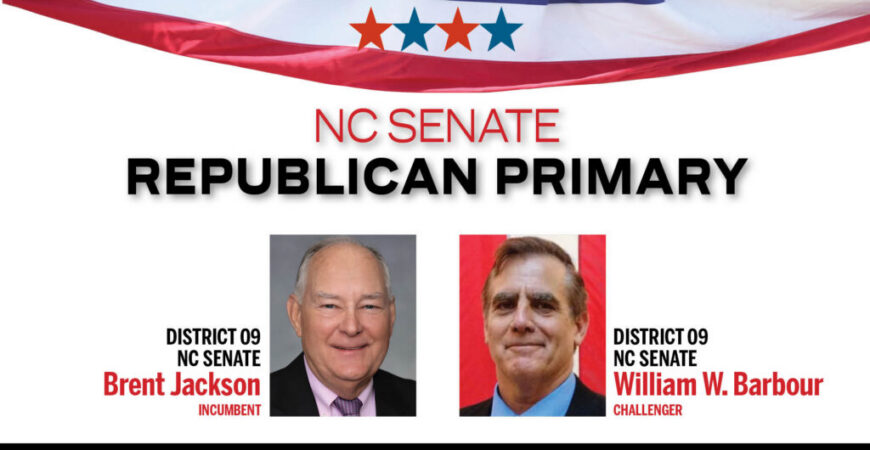
Incumbent Brent Jackson and Challenger William W. Barbour are competing in the Republican NC Senate District 9 primary. Both candidates were invited to participate in Duplin Journal’s Candidate Q&A. Barbour did not respond.
Brent Jackson
What are two of your most significant accomplishments within your district, particularly in Duplin County, and how have these achievements directly impacted the community and its residents?
One of my most significant accomplishments for Duplin County has been securing state funding for critical infrastructure and economic development projects that rural communities often struggle to advance on their own. Recent examples of this include:
- $400,000 secured for the Town of Kenansville for capital projects
- $5,000,000 to the Town of Wallace to construct an administrative building to co-locate fire and police services
- $8,000,000 to the Town of Kenansville for water and sewer improvements
- $12,000,000 to Duplin County for economic development, including infrastructure improvements
- $4,000,000 to James Sprunt Community College for a workforce development center and related capital improvements or equipment
- $200,000 to Duplin County for volunteer fire departments
- $250,000 to the Town of Rose Hill for capital improvements and equipment at the Rose Hill Fire Department
- $11,000,000 to Duplin County for public safety facilities, including planning and construction of a co-located sheriff’s office and detention center
These projects don’t always make headlines, but they are foundational, supporting job creation, attracting private investment, and ensuring that existing businesses, particularly in agriculture and food processing, can continue operating and expanding without capacity constraints.
Another major accomplishment has been my consistent advocacy for agriculture and rural economic stability, which is the backbone of Duplin County. I have worked to protect farmers and agribusinesses from overregulation while also supporting disaster relief funding following hurricanes and flooding events that disproportionately impact eastern North Carolina. These efforts have directly helped family farms recover, protected jobs, and preserved the tax base that funds schools and local services. Agriculture touches nearly every household, so standing up for this industry means standing up for the entire community.
Which goals in your district have proven the most difficult to achieve, and what specific challenges or obstacles have contributed to these difficulties? How have you addressed these challenges, and what lessons have you learned that could guide future initiatives?
One of the most difficult challenges has been modernizing aging infrastructure in small towns with limited tax bases, particularly wastewater and utility systems. These projects are expensive, highly regulated, and often require coordination across multiple levels of government. For rural municipalities, even securing matching funds can be a major obstacle, and delays in permitting or funding cycles can stretch projects out for years. I have worked hard to limit those obstacles, but it does take time and much of the regulation is federal so that’s a whole other level.
I have addressed these challenges by working closely with local officials to navigate state grant programs, advocating for flexibility in funding requirements, and pushing for a more realistic understanding in Raleigh of what rural communities can afford. The lesson I’ve learned is that one-size-fits-all policies don’t work for rural North Carolina. Future initiatives must account for local capacity, provide technical assistance, not just funding, and streamline processes so small towns aren’t overwhelmed by bureaucracy.
Wastewater management has become a critical concern in areas such as Warsaw and Mount Olive. What concrete initiatives would you champion in the North Carolina Senate to ensure sustainable wastewater solutions for rural counties, benefiting both residents and businesses? Additionally, how do you determine and prioritize where state funding should be allocated to maximize impact?
Wastewater is one of the most pressing issues facing rural communities, and it directly affects public health, environmental quality, and economic development. In the Senate, I would continue to champion targeted state investment in wastewater treatment upgrades, regional systems, and capacity expansions. I also support expanding grant programs that reduce the reliance on debt for small municipalities and encourage regional cooperation where it makes sense.
When prioritizing funding, I look at three key factors: public health, economic impact, and a community’s ability to execute the project. Projects that unlock job growth, prevent health risk, or serve multiple communities should rise to the top. Just as importantly, I believe the state should provide engineering and planning guidance to help towns move projects from concept to completion, because funding alone isn’t enough if a town lacks the capacity to manage complex infrastructure upgrades.
How will you ensure that the voices of Duplin County residents are actively heard and considered in state-level decision-making processes, especially on issues that directly affect their daily lives?
I have always believed that effective representation starts with accessibility and communication. I make it a priority to maintain regular contact with local officials, business owners, farmers, and all residents throughout Duplin County—not just during election seasons. Listening sessions, one-on-one meetings, and responsiveness to constituent concerns are essential to making sure Raleigh understands what’s happening on the ground. It is something I take very seriously, I give my cell number out to anyone, so I am always reachable by all my constituents.
In the legislature, I serve as a voice for rural eastern North Carolina by bringing local concerns directly into committee discussions and budget negotiations. Whether it’s infrastructure, public safety, education, or agriculture, I work to ensure that policies reflect the realities of communities like Duplin County. Representation isn’t about speaking for people; it’s about making sure their voices are carried into the room where decisions are made.
What legislation or measures would you pursue to improve transparency, accountability, and oversight in local governments, particularly in municipalities currently facing governance concerns? Would you support specialized audits, reviews, or other interventions to restore public confidence in local leadership?
Transparency and accountability are essential to maintaining public trust, especially at the local level where decisions directly affect residents’ daily lives. I support strong oversight mechanisms, including targeted audits and financial reviews when there are clear warning signs of mismanagement or governance breakdowns. These tools should not be punitive, but corrective, focused on identifying problems early and helping local governments get back on stable footing.
I would also support measures that improve financial reporting, board training, and access to state technical assistance, particularly for small municipalities with limited staff and expertise. When governance concerns arise, the goal should always be to restore confidence, protect taxpayers, and ensure continuity of essential services. The state has a responsibility to step in thoughtfully and constructively when needed, while still respecting local control and empowering communities to succeed. I believe our new state auditor is doing a great job in the first year to tackle some of these issues and as a member of the Senate I’ll continue to support his efforts.
William W. Barbour
Barbour did not respond.