 Twitter
 Facebook
 Instagram
MOUNT OLIVE — The regular monthly meeting of the Mount Olive Town Board of Commissioners was once again the scene of some fiery exchanges between commissioners, and at times, the mayor.
The most contentious exchange happened during a non-action item on the agenda regarding the cost of the fee charged by the town to reconnect water service if it was discontinued after non-payment of the bill. At last month’s meeting, Town Manager Glenn Holland announced the town would be reinstituting the disconnect charges due to the town having $149,128 in past due water bills.
Mayor Pro Tem Delreese Simmons told the board he was concerned the $100 disconnect charge, in addition to a late fee, was too steep. He said the board should consider cutting the disconnect charge in half, to $50.
Commissioner C.J. Weaver read from an email from Caroline Bari, from the North Carolina Department of Environmental Quality, Division of Water Infrastructure, who has been assisting Mount Olive in its efforts to relieved from a sewage capacity moratorium issued by the state that is preventing the town from issuing new building permits, basically bringing growth in town to a halt.
“It is imperative that the town implement a collection policy that enables the town to responsibly operate and maintain the water and wastewater treatment systems,” Weaver read from the email. “To that end, please consider the following. All users; residential, commercial and industrial; should pay for the cost of services. Collections policy should be applied consistently and to all customers, no exceptions.”
Simmons challenged Weaver saying the email referred to rates and not disconnect fees. He also accused Weaver of saying a business customer had received special privileges after getting their water cut off, a charge Weaver denied, saying Simmons had misquoted him.
Ironically, Simmons himself came under fire last year when an audit of the town’s billing practices by the North Carolina State Auditor’s Office revealed he had not paid a water bill account in his name for months and the water service had not been disconnected and he had not been charged late fees.
The discussion of the disconnect fee was not up for a vote at this meeting, but will likely be tackled at an upcoming meeting.
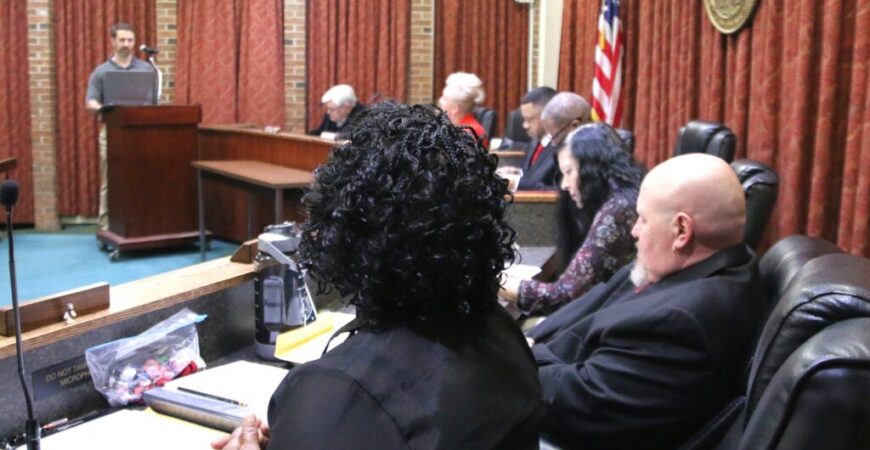
Another lengthy discussion occurred during a report on a revised Townwide Storm Water Treatment Master Plan presented by David Honeycutt, a project manager and engineer with McGill Associates, the company hired to create the plan under a grant.
A public hearing on the plan was held at the board’s November meeting last year which resulted in commissioner and citizen input to add several additional areas in town that were subject to flooding after heavy rains.
During Honeycutt’s presentation, both Mayor Jerome Newton and Simmons appeared to interrogate him as he attempted to make his presentation.
Honeycutt was attempting to update the board on the revised plan when Newton appeared frustrated and interrupted him.
“If you could just speak more in general terms and just explain. It appears that you’re reading,” Newton said.
“I’m actually not reading, other than to look at the number of events,” Honeycutt replied.
When asked by Newton to jump to what the fixes are, Honeycutt said, “From a big picture perspective, these are costly and challenging fixes.”
He said just the repair of the flooding from stormwater at the town’s Piggly Wiggly would be a $20 million fix.
Commissioner Gena Messer Knode asked Honeycutt, “We don’t have $20 million, so why should I say yes to this plan.”
Honeycutt explained that the grant was for his firm to create the plan to handle the issue, not to determine the methods to pay for the repairs needed.
Simmons asked if handling the stormwater problems would help relieve the town of the state-mandated wastewater moratorium.
Honeycutt responded that the plan was specifically to handle stormwater. As he attempted to explain how stormwater could add to the sewage issue, Simmons interrupted him.
“I just want the people to know, his grant, it don’t matter. If we don’t go no farther with it, it’s not going to hurt us. All he’ll do is get paid and go on about his business,” said Simmons.
The Storm Water Plan does matter to the Town of Mount Olive. Town Clerk Sherry Davis told the board approving the plan could be a precursor to the town receiving future grants to address storm water issues.
Weaver told Honeycutt, “You were hired by the grant money to do a job. You did it. We can use the information, and if we go forward we may [be able to] use the information to get other grants.”
After Weaver’s comments, the board voted to approve the plan.
Holland reported to the board that several notices of violation had been issued by the state due to the sewage treatment system not operating properly. Holland placed some of the blame on new state inspectors, who were ignoring previous inspectors’ instructions to continue to operate the system “as it was intended” despite the system not being approved to operate in that manner. He also said the town is working with TRC Engineering and the N.C. Department of Water Quality to create a program to control illegal industrial discharges that are being introduced into the sewer collection system.
After holding a public hearing early in the meeting, the board voted to name the Mount Olive Town Hall office annex in honor of the late town manager Jammie Royall.